Science Begins at P3.
And It Demands Precision From Day One.

Your child spends P1 and P2 building language and number foundations. Then P3 arrives — and suddenly there is a new subject, five themes, a marking scheme, and a way of writing answers that school simply does not have time to drill. Science at PSLE is not just about knowing facts. It is about using them precisely, in the language examiners are trained to reward.

5 Themes · P3–P6
CER Method
MOE 2023 Updated Syllabus
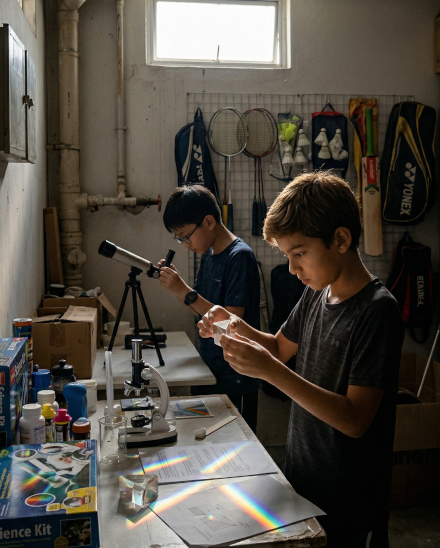
Singapore student studying Primary Science
🐕
MOE Science Curriculum Framework

Five Themes. Every Topic Belongs to One.

MOE organises the entire P3–P6 Science curriculum across five themes. Understanding the theme behind each topic helps children connect ideas across years.

Diversity

Living vs non-living things, types of animals and plants, classification, and diversity of materials. Builds the ability to observe and compare systematically.

Cycles

Life cycles of animals and plants, the water cycle, states of matter, and reproduction. Understanding that patterns of change repeat helps students predict natural events.

Systems

Plant systems, human digestive, respiratory, and circulatory systems, and electrical systems. Questions always ask how each part's function contributes to the whole.

Level-by-Level Syllabus

What Changes at Every Level.

From 2024, each primary level has its own dedicated Science syllabus — there is no longer a shared "lower block."

P3
First Year of Science

Science is a new subject at P3. The vocabulary of classification, characteristics, and functions must be learnt from the start.

Living & non-living things Diversity of materials Magnets
P4
Systems Introduced

P4 introduces the first "systems" — plant parts and human digestion — which require students to name parts and describe functions.

Plant system Human digestive system Light & Heat
P5
Heaviest Content Year

P5 is the most content-dense Science year. Reproduction, water cycle details, two body systems, electrical systems, and photosynthesis.

Water cycle Respiratory & Circulatory systems Photosynthesis
P6
PSLE Year

P6 Science is dominated by forces and ecology. PSLE open-ended questions require precise vocabulary and the CER structure.

Forces Adaptation Food webs
Superholic Lab's Science Differentiator

The CER Method — What Examiners Are Looking For.

Most students know the content. The ones who lose marks write the right idea in the wrong structure. PSLE Science open-ended answers must follow Claim → Evidence → Reasoning to score full marks.

C — Claim

A direct answer to the question. No hedging. No "I think." One clear statement of what happened or why.

E — Evidence

Data or observations from the question that support the claim. Must reference the specific information provided.

R — Reasoning

The science concept that explains WHY the evidence supports the claim. This is where PSLE marks are won or lost.

Question: Why did the plant in Pot A grow taller than the plant in Pot B?
❌ 0 marks — Common student answer

"Because Pot A had more sunlight and sunlight helps plants grow."

No evidence from the table. No mechanism explained.

✓ 3 marks — CER structure

"Plant A grew taller because it received more sunlight. The table shows Pot A reached 24 cm while Pot B reached only 15 cm. Sunlight provides energy for photosynthesis..."

Claim stated clearly. Evidence cited. Reasoning linked.

Build PSLE Science Confidence — Topic by Topic.

MCQ with wrong-answer explanations. Open-ended with CER coaching. Miss Wena as your child's personal Science tutor. 7-day free trial — no credit card required.